• Skip to secondary menu
  • Skip to main content
  • Skip to primary sidebar
  • Skip to footer
  • Home
  • About Me
    • Privacy Policy
    • Disclaimer, Legal and Media Kit
  • Blog
  • Contact me

A Net in Time

Curriculum and book reviews, faith, homeschooling and more!

  • Art
  • Blogging Helps
  • Faith
  • Homeschooling
  • Poetry
  • Recipes
  • Reviews
  • Writing

How to's

Balancing Work and Homeschooling

September 25, 2017 By Annette1 12 Comments

The other day Jen asked for people to give her a brief outline of how working parents  balance out schooling their children with their jobs.  It’s not always easy to balance commitments you know? Especially if you have a household to run, friends to keep in contact with and the host of things distracting us. 

So just what is it that I do?   What am I trying to balance?


My Work
1. AT Home Pets.   Raising and selling rabbits.
2. Grading Papers for a on-line course, biology and physics
3. Doing Reviews.  Mystery shops, curriculum, books.

My Student:
One 12 year old lad.

Now I have to admit, my work doesn’t tend to Take me out of the home, but it does on occasion… especially when I have mystery shops to do. 

It helps that I have a focus on raising an independent lad.  I want him free to ask me for help, but I also want him to work independently, so over the years I’ve worked toward that end.   We aren’t there yet, but it’s getting better.  ๐Ÿ™‚

I thought I’d walk you through a week so you see how I mostly balance things out.

Sundays: mostly I stay off my computer until the evening. Church in the morning, walks in the afternoon, etc.  I often will mark papers while chilling with hubby in the evening.   

Monday: MOST of my bunny sales take place on Mondays, since people often want delivery to London.   The lad hangs out at gramma’s house, occasionally selling a rabbit for me, but usually I drop them off for people.   This is time for hubby and I to run errands together and just enjoy time out with each other… going for bike rides, walks, a movie etc.  The lad does most of his schooling while hanging out with gramma now… sometimes though she gives him a Monday off and takes him out for the afternoon.  ๐Ÿ™‚

Tuesday: This is my laundry and housework day.   I kibbitz about the house while the lad does his schooling.  We talk and read together.  We aim to, though don’t always manage, have game night on Tuesdays.   Tuesday nights I try to read other blogs and stay in contact with people. 

Wednesday: We do the foodbank in the morning, home for lunch, then I head out to the library to work on book and curriculum reviews.  On good days, if I have the ground work done (pics taken, basic posts up) I can get up to nine posts done in an afternoon (otherwise the most I get done is three).  Wednesday night I work on blog posts while hubby is out doing karate with the lad, and then while chilling at night.

Thursday: I focus on my rabbitry and website. If I have bunnies for sale I list them on kijiji, I update pictures weekly, and write the odd blog post. This is the day I do rabbit maintenance, like clipping nails, taking pictures, and such like.   If I get done in good time (normally takes about five hours), I’ll mark some more papers. 

Friday: Fun schooling.  This means things like Co-op days, STEM, art projects, research projects, going on field trips and more.   It’s a relaxed do what we can day… we all learn something.  ๐Ÿ™‚   Each week this varies… except when we have co-op days for six weeks in the fall and spring. Outside pressures eh?  But also outside fun like visiting with friends afterwards, or taking in a movie unexpectedly.  ๐Ÿ™‚

Into this mix we throw in learning events with the various local groups… in fact today my lad is learning about Canada’s role in WW2. 

Saturday: Ah.. ANYTHING can happen on Saturday.  ๐Ÿ™‚   Big projects, lazy days, blog work, family “let’s get out of the house days” .. anything.  

Things like mystery shops I fit in as they pop up.   Sometimes that means dragging the lad along “mom, this is boring” or leaving him at home with Dad or if in town, by himself.  He’s good at staying on task if going out the a.m.   It all manages to work out.

The biggest key I find is remembering this: there is always tomorrow.   I try to always have things done early so I don’t have that pressured time crunch to work with.   But there is always tomorrow, so if it doesn’t get done today, it will mostly get done the next. 

This post may contain affiliate links – using affiliate links from A Net in Time helps fuel this blog and our homeschool – thank you!

ยฉ2006-2017 A Net In Time. All rights reserved. All text, photographs, artwork, and other content may not be reproduced or transmitted in any form without the written consent of the author. A Net In Time . We are a participant in the Amazon Services LLC Associates Program, an affiliate advertising program designed to provide a means for us to earn fees by linking to Amazon.com and affiliated sites
Filed Under: Uncategorized Tagged With: homeschool, How to's

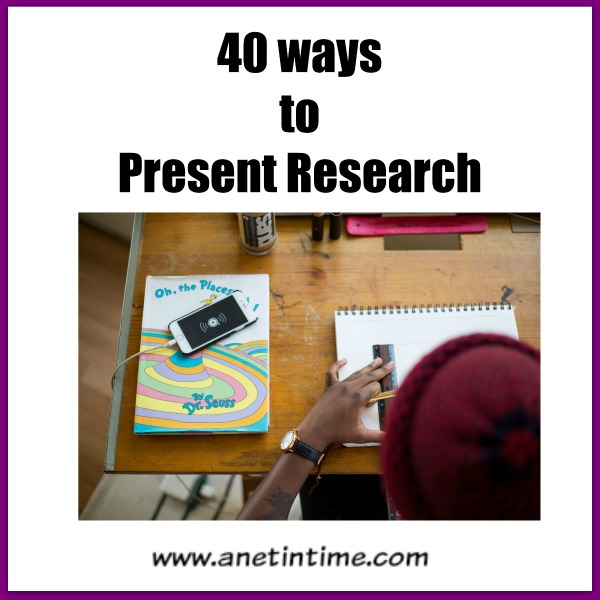
40 Ways in Which to Present Research

September 18, 2017 By Annette1 10 Comments

Presenting research is an integral part of schooling.  It can be done simply by talking, but often times in the business world you need to be able to show your audience such as you boss or team members, the material you’ve gathered in different ways.  Practicing this skill in your formative years helps you to hone your abilities. 

This is something that we are focusing on with the lad this year.  Hopefully each week, but at least a couple times a month, he will be presenting his research in a method of his choice from a list that we give him.

This is our list:

  1. Diorama/shadow box
  2. Essay
  3. Picture essay (using drawings or photos)
  4. Video
  5. Slide Show Presentation
  6. Poster
  7. Create a cartoon/comic
  8. Write a script
  9. Puppet Show
  10. Design a theatre poster/billboard
  11. Create an advertisement
  12. Write a cartoon
  13. Design a model – lego, papercraft, clay etc
  14. Write a poem
  15. Lab Report
  16. Animal report – name, habitat, classification
  17. Compose a song
  18. Five minute speech 
  19. Timeline
  20. Make a board game incorporating key elements
  21. Create a flow chart or diagram
  22. Make a word search
  23. Make a postcard
  24. Make a question and answer key
  25. Create a set of task cards
  26. Design an interactive notebook
  27. Make a pamphlet
  28. Write a newspaper article
  29. Use a Venn Diagram to compare two aspects of the topic
  30. Create a map
  31. Decorate a box and fill it with relevant objects
  32. Create a flip book
  33. Create a scavenger hunt about your topic
  34. Do a Newscast
  35. Write an advice column (or a video) about a problem with your topic
  36. Write a glossary of relevant terms
  37. Write an instruction booklet
  38. Make a bookmark
  39. Make a top 10 list
  40. Design a book cover

All the lad has to do is choose one of these methods in order to present his information and then present it.  It will hopefully stretch him and teach him a few things.  He can’t repeat a method unless he talks to us. My goal is to keep all his projects to present at a Project Fair at the end of the year.  He wants to base most of his research projects around his current favourite topic: ANTS. 

Why have all these different methods to present research?
It’s good to keep creative juices flowing, it will help him see there is more than one way to show his work, it will help him see the joy of being concise, and the need for less brevity.   Some of his work will coincide with crafts he’s making for a children’s Christmas sale, so he can kill two birds with one stone. 

—-
Image used from Photo by Tamarcus Brown on Unsplash

This post may contain affiliate links – using affiliate links from A Net in Time helps fuel this blog and our homeschool – thank you!

ยฉ2006-2017 A Net In Time. All rights reserved. All text, photographs, artwork, and other content may not be reproduced or transmitted in any form without the written consent of the author. A Net In Time . We are a participant in the Amazon Services LLC Associates Program, an affiliate advertising program designed to provide a means for us to earn fees by linking to Amazon.com and affiliated sites

Filed Under: Uncategorized Tagged With: homeschool, How to's, Research

Homeschooling with Toddlers

September 20, 2007 By Annette1 Leave a Comment

I get a newsletter from Knowledge Quest.

This week they had a link to an article on homeschooling with toddlers in the house. I thought it interesting and helpful.

There are three strategies to use when homeschooling with toddlers in your home and these are 1. Keep them busy, 2. Divide and Conquer and 3. Get Creative.

Some of the ideas listed I liked.
like the one about having a preschool box with activities to do. Just stuff ready to do in a ziploc bag. Takes a bit of prep work…but makes it easier later on.

This one I do all the time:

Put the step stool up to the kitchen sink, close the drain and run a drizzle of water into the sink along with a little bit of dish soap. Give your child some plastic cups, bowls and spoons to “wash”. He’ll feel glad to know that he is helping with the chores.

The divide and conquer I haven’t had to use too much. I only have the one boy…though two dogs so sometimes hubby watches the boy while I walk the dogs. ๐Ÿ™‚ Does that count?

So anyways, check it out. Good ideas to be found there.

Filed Under: Uncategorized Tagged With: How to's

Scheduling Downloads

September 7, 2007 By Annette1 Leave a Comment

The Old Schoolhouse sent me to this site for free downloads. Give them your name and email address and you get these downloads.

~ Microsoft Excel Family Budget ~ Children’s Chore Chart (editable, with clip art) ~ Editable Daily Schedule (MS Word) ~ Two editable planner pages (one home management, one homeschool) ~ Love Coupons for Married Couples ~ Bible Memory Verse Posters (set of five, illustrated with clip art) ~ Homeschool Grade Book/Report Card Generator (MS Excel)Free scheduling downloads. Sure helps with me not having to start from scratch. Must say though, some I think I would modify for my own personal taste.

Filed Under: Uncategorized Tagged With: Friday Freebies, How to's, Scheduling

How to analyze information

September 3, 2007 By Annette1 Leave a Comment

I have to admit, I found this interesting. How to analyze Information.
Step one: Figure out where you are

Until you know “where you are” you cannot make good use of the available information. That’s because you cannot know what specific information you’ll need next, or what the information you’ll be looking at when you get it will mean. So take the time to figure out “where you are” – literally or metaphorically — before moving on to the next step.

Step two: be sure you are seeing clearly

When we deal with information, we sometimes see through prisms – not real ones, made of glass, but “intellectual” prisms, in our minds. In other words, we approach an issue with a distorted view of it. ….. The key to seeing information clearly is to make certain there isn’t a prism between you and whatever you are looking at. …….. Seeing information clearly, just as knowing where you are, means you need to have a generally accurate idea of whatever person, place, organization, situation, or issue that you’re looking at.

Step three: Decide what you need to decide

“The question is more important than the answer.” …….. In other words, sometimes you must pause for a moment to be sure you’re asking the right question.

Step four: determine what you need to know

What ingredients are to a meal, information is to a decision. Once you’ve decided what you’re going to decide, the next step is to make a list of the information you’ll need to make that decision.

Step Five: Collect your information

The first thing you need to figure out is the most reliable source for each piece of information you need: …….
You’ve already made a list of the information you’re going to need. Now, next to each item, write down the most reliable source for it – a government agency, a university or another organization such as a business or an industry association, or specific individuals. Now it’s time to figure out the best way to collect the information from the sources you’ve identified: …….Give yourself as much time as possible to collect all the information you need. If you’re lucky, the “information supermarkets” will supply everything through the websites to which they link. If you’re not so lucky, you’ll start with the “information supermarkets” and then go on to look up information in books, magazines, and by talking with people in person, on the telephone, or by email. Sometimes you will be able to do all this without ever leaving your chair. Other times you’ll need to visit a library, meet with someone in person, or even travel to another city or country. As a general rule, you’ll discover that there is always one source – one website, for instance, or one person – where the correct answer to your question can be found. Keep going until you find this source.

Step Six: Turn The Information into Knowledge

As you study the information you’ve collected, the first thing to look for is facts.

As you continue to study the information you’ve collected, you must also keep an eye out for patterns. …. This is how you will make sense of the information.

By studying the information you’ve collected until you have determined the facts and seen the patterns it contains, you have turned raw material into a finished product. You have turned information into knowledge.

Step seven: Add the final ingredient

Before actually making your decision, there is one final ingredient you will add whether you want to or not: your own judgment. Judgment is the sum total of who we are – the combined product of our character, our personality, our instincts and our knowledge. Because judgment involves more than knowledge, it isn’t the same thing as education. You cannot learn judgment by taking a course, or by reading a book. This is why some of the most highly educated people in the world have terrible judgment, and why some people who dropped out of school at the age of sixteen have superb judgment. After all, the most visible pattern in the world is that different people respond to the same circumstances in different ways. Some people are naturally sensible, while others are naturally foolish. Some people enjoy taking risks, while others tend to be cautious. Some people are congenital optimists, while others are always pessimistic. Some people just seem to have good instincts, for instance about other people, or about technical issues such as whether the price of crude oil will rise or fall in the coming months. Other people’s instincts always seem to lead them astray. Now you can understand why two people, facing the same decision and armed with precisely the same information, will make different choices. As you reach your decision, you will be combining the knowledge you’ve gained from the information you’ve collected with your own character, your own personality, and your own instincts. You cannot help but do this, because you are a human being and not a machine. At least in the short term, there is little you can do to change your judgment. It’s who you are. But if you are aware of who you are – and if you have worked hard to collect information and then to turn this information into knowledge — you will be more likely to make the decision that’s right for you. And this, of course, is what analyzing information is all about.

As the Author states:

Our world is wonderful and infinitely fascinating. But it is also complicated, and therefore very dangerous. If we are to live in peace, freedom and prosperity — if the human species is to survive — we must learn to rely more on our minds than on our muscles. We must force ourselves to value wisdom above strength. And this is why it’s worth the time and effort to master the steps I’ve outlined here. When you learn how to analyze information, you are really learning how to think.

Filed Under: Uncategorized Tagged With: How to's

  • « Go to Previous Page
  • Page 1
  • Page 2

Primary Sidebar

ABOUT ME

I am centered by the love of God and family. Smiles are brought about being a Writer, Poet, Hiker and reader. Growth occurs as I educate my son, raise him up in the fear of the Lord, love up on my critters and live as a pastor’s wife.

Want to Stay Informed?

Subscribe and I’ll shoot you an email once a week.


Thank you!

You have successfully joined our subscriber list.


Recent Posts

  • A Shift in Perspective
  • Affording Emergencies
  • Obey God Not Man
  • Just a Phase
  • What Route Should I Take?

Recent Comments

  • Annette1 on A Shift in Perspective
  • Annette1 on A Shift in Perspective
  • Sandra K. Stein on A Shift in Perspective
  • Tami on A Shift in Perspective
  • Annette1 on A Shift in Perspective

Archives

Categories

  • Art
  • Art Books
  • Blogging Helps
  • Faith
  • Homeschooling
  • Poetry
  • Recipes
  • Reviews
  • Uncategorized
  • Writing

Footer

Amazon Affiliate information

A Net in Time is a participant in the Amazon Services LLC Associates Program, an affiliate advertising program designed to provide a means for us to earn fees by linking to Amazon.com and affiliated sites

Tinker Crate Affiliate

Copyright © 2026 A Net In Time. All rights reserved. All text, photographs, artwork, and other content may not be reproduced or transmitted in any form without the written consent of the author. A Net In Time ยท Lifestyle Pro - Child Theme On Genesis Framework ยท WordPress ยท Log in